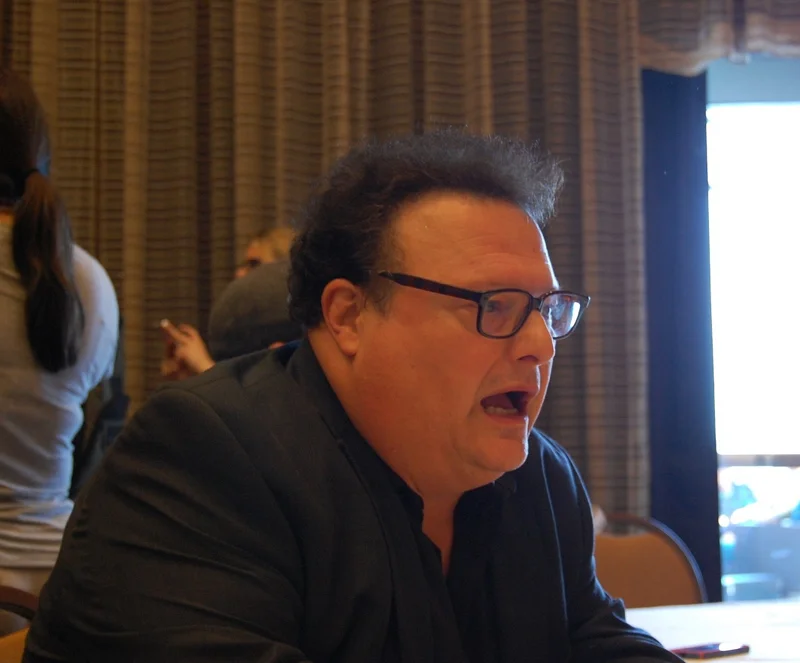
Wayne Knight at a convention (2013)
Wayne Knight
Public appearance; Commons describes the setting as SDCC 2013. The metadata date is retained without asserting the precise convention day.
Entry point: Seinfeld (1992–1998).
Explore the career in pictures
Updated
Wayne Knight built a screen career around characters who can turn an ordinary conversation into a confrontation. His Newman in Seinfeld makes a hallway encounter feel like a contest, while Dennis Nedry in Jurassic Park turns a technical job into a consequential act of sabotage. Those parts are memorable introductions, but they sit alongside theatre, ensemble sitcoms and animation. His performances reward attention to the moment when a polite exchange becomes competitive: a pause, a change in volume or an unexpectedly elaborate explanation can supply the turn.
Knight was born in New York City in 1955 and grew up in Georgia. His early acting work included theatre before he became a familiar television face. Broadway credits include Gemini and Mastergate, followed by Art, where he joined Buck Henry and George Segal in 1999. That three-person play offers a useful point of comparison with a television guest role. The actors must sustain changing alliances over a longer argument, making listening and reactions as important as a separately memorable punch line or entrance.
Newman became a recurring adversary in Seinfeld during the 1990s. Knight played the postal employee as a man with his own grievances, loyalties and grand explanations. The character works especially well against Jerry’s restrained responses and Kramer’s willingness to take a scheme seriously. A rewatch can follow an exchange through the other performers rather than isolating Newman’s lines: the scene often depends on how long someone lets him continue. His confidence and the disproportion between his rhetoric and the immediate problem create much of the comedy.
Jurassic Park placed Knight in a different kind of ensemble as Dennis Nedry, the computer programmer whose attempted theft undermines the park’s systems. The 1993 film uses comic frustration inside an adventure story with dangerous consequences. Nedry’s encounters with his employer and his increasingly uncomfortable escape make a compact character arc. Knight also appeared in JFK and Basic Instinct, where interrogation and investigation shape the scenes. These films show how a recognizable supporting performer can help establish pressure without carrying the entire narrative.
His television work extends beyond Newman. As Don Orville in 3rd Rock from the Sun, he entered the orbit of a family whose behavior follows an entirely different comic logic. Haskell Lutz in The Exes brought him into another recurring ensemble. These roles are worth comparing through relationships rather than treating every irritated or self-assured character as a variation of one person. The setting changes who holds authority, who understands the situation and who has to repair a social mistake after the immediate joke has landed.
Knight’s animation credits include Tantor in Disney’s Tarzan and Al McWhiggin in Toy Story 2, both released in 1999. Voice work shifts the performance toward rhythm, breath and vocal reactions while animators supply the visible action. In live-action and animation together, Space Jam gives him the part of Stan Podolak. Moving between these films illustrates the practical range of a character actor: the voice may be immediately recognizable, but the scale of a reaction has to fit a creature, a toy collector or a human sharing the frame with animated players.
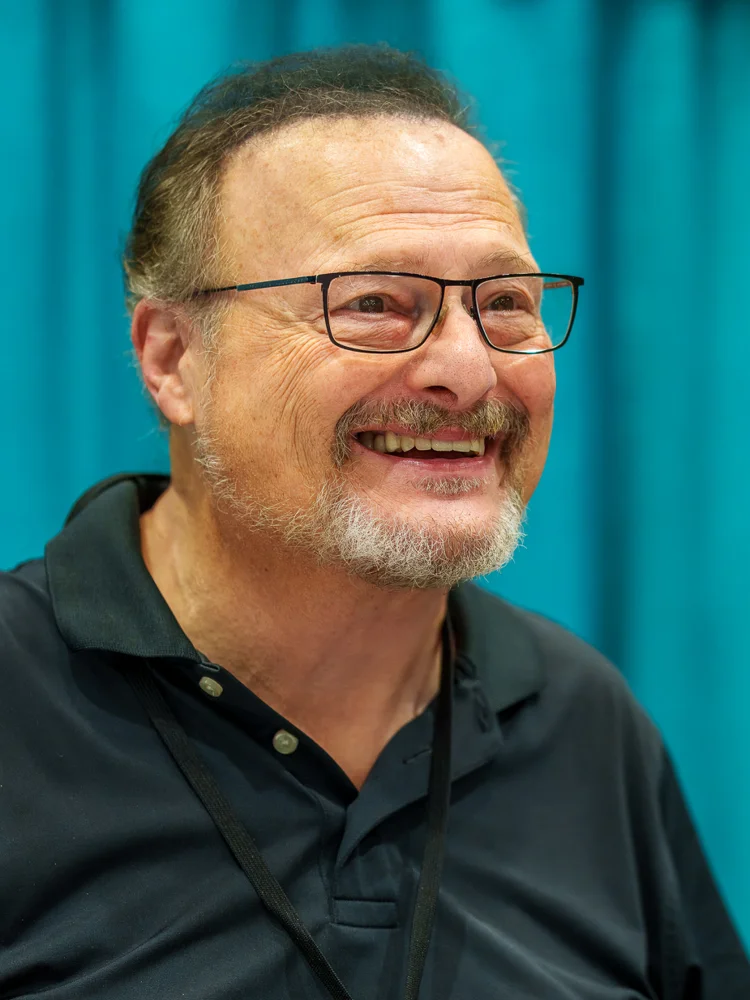
The gallery presents two separate public appearances: a 2013 convention photograph and a 2025 GalaxyCon Raleigh photograph. They document Knight’s public career and are not stills from Seinfeld or Jurassic Park. Their creators, source pages and share-alike terms remain in the acknowledgments, including the terms for the resized derivatives. For a viewing route, begin with a Newman episode, contrast it with Nedry’s storyline, then listen to Tantor or Al. The changing balance of voice, facial reaction and ensemble timing reveals more than a list of familiar characters alone.
Two distinct convention photographs document public appearances in 2013 and 2025. These are career photographs, not fictional character portraits.
Wayne Knight
Public appearance; Commons describes the setting as SDCC 2013. The metadata date is retained without asserting the precise convention day.
Wayne Knight
Photographed by John Manard on July 25, 2025; a public appearance, not a production still.
GalaxyCon: Wayne Knight career profile
https://galaxycon.com/blogs/celebrities/wayne-knight
Playbill: Henry, Segal and Knight join Art
https://playbill.com/article/henry-segal-knight-join-bways-art-may-11-com-81800
Disney: Tarzan cast and release
https://movies.disney.com/tarzan
Wayne Knight career and credits
https://en.wikipedia.org/wiki/Wayne_Knight
Commons: portrait provenance and license
https://commons.wikimedia.org/wiki/File:Wayne%20Knight2013.jpg
Corrections: hello@dailytimecapsule.com
Work: Wayne Knight2013.jpg
Creator: jennybento
Date: 2013-08-26
Original source: https://commons.wikimedia.org/wiki/File:Wayne%20Knight2013.jpg
Primary archive: https://commons.wikimedia.org/wiki/File:Wayne%20Knight2013.jpg
License: CC BY-SA 2.0
License URI: https://creativecommons.org/licenses/by-sa/2.0
Changes: Resized and converted to WebP; portrait also placed in a titled share image. No endorsement implied. These image derivatives remain available under CC BY-SA 2.0.
Rights scope: No endorsement implied. See the stated license and modification notice.
Work: Wayne Knight (54691451703).jpg
Creator: John Manard
Date: 2025-07-25
Original source: https://commons.wikimedia.org/wiki/File:Wayne%20Knight%20%2854691451703%29.jpg
Primary archive: https://commons.wikimedia.org/wiki/File:Wayne%20Knight%20%2854691451703%29.jpg
License: CC BY-SA 4.0
License URI: https://creativecommons.org/licenses/by-sa/4.0
Changes: Resized and converted to WebP; portrait also placed in a titled share image. No endorsement implied. These image derivatives remain available under CC BY-SA 4.0.
Rights scope: No endorsement implied. See the stated license and modification notice.