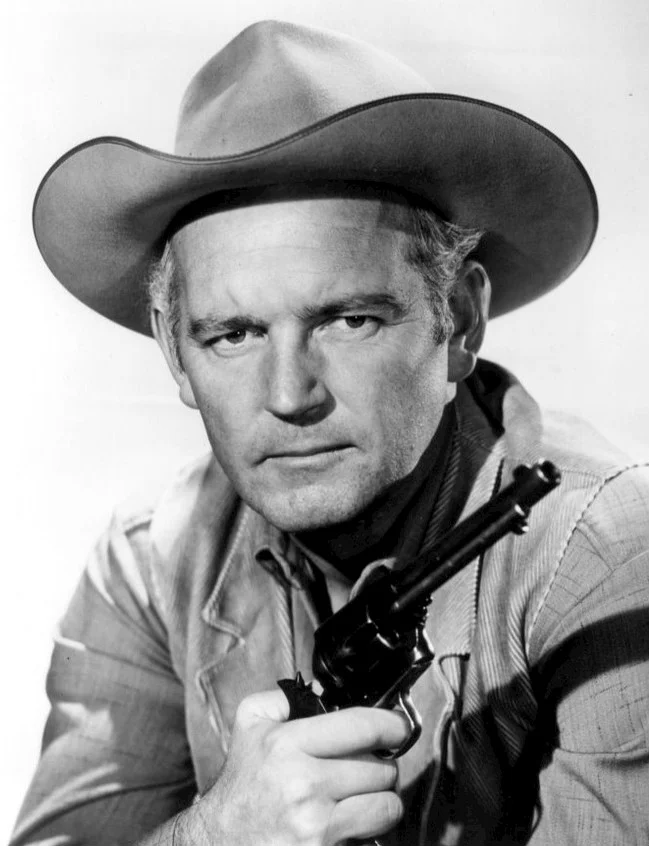
Wagon Train: Bill Hawks (1962)
Bill Hawks
Series publicity portrait identifying Wilson as the assistant wagonmaster.
Entry point: Wagon Train (1957–1965).
Explore the career in pictures
Updated
Terry Wilson was an American actor and stunt performer best remembered as Bill Hawks, the assistant wagonmaster on Wagon Train. Born in Huntington Park, California, on September 3, 1923, he belonged to the generation of performers whose experience with horses and action work could lead into regular television acting. His best-known role made him a familiar presence across the western series’ entire run, from 1957 to 1965. This biography concerns that performer, rather than the athletes, scientists and other people who share his name.
Before becoming a series regular, Wilson worked in motion-picture stunts, including doubling Robert Mitchum in Pursued. His professional circle brought him into contact with John Ford, Ward Bond and fellow stunt performer Frank McGrath. INSP’s retrospective describes how that working relationship developed into the Wagon Train ensemble. The transition matters: Wilson arrived with practical experience in the physical business of western filmmaking. Bill Hawks was a speaking character with continuing responsibilities, but the job also drew upon skills that had already occupied Wilson behind more prominently billed actors.
Wagon Train combined a recurring group of travelers and staff with stories built around visiting characters. Bill Hawks helped provide continuity while the weekly narrative introduced a different guest star or personal dilemma. The Museum of Broadcast Communications places the series between the western adventure and the television star vehicle. That structure helps explain the value of an actor who remained with it for so long. Hawks did not have to dominate every story to make the moving community feel like the same place from one episode to another.
Wilson and Frank McGrath, who played cook Charlie Wooster, remained regulars through the series’ changes of leading players, network and running time. Ward Bond’s Major Adams and John McIntire’s Chris Hale belong to different phases of its history, while Hawks links those phases. An effective way to watch Wilson is to compare his scenes across seasons. The surrounding cast and immediate predicament may change, but the assistant wagonmaster’s place in the group gives viewers a familiar point of reference. The ensemble publicity photograph here records one particular configuration, not the entire eight-season cast.
After Wagon Train, Wilson continued to appear in western films and television. His credits included The Shakiest Gun in the West, Dirty Dingus Magee and Support Your Local Gunfighter, alongside appearances in series such as The Virginian, Gunsmoke and Hec Ramsey. These later assignments allow a useful comparison with his long-running regular role. A guest part has to establish its relationship to an existing story quickly, whereas a series character can accumulate meaning through repeated appearances. Both kinds of work belong in an account of a supporting actor’s career.
Wilson also played Biff Jenkins in Disney’s Escape to Witch Mountain in 1975, a reminder that his screen record extends beyond western settings. His career illustrates the overlap between stunt work, supporting film parts and recurring television employment during the studio-to-television transition. That history can be obscured when an actor is remembered almost exclusively by one character’s name. Hawks remains the most direct introduction, but following the later credits reveals additional settings and different scales of assignment. The selected titles below are viewing landmarks rather than a claim to reproduce every appearance.
Wilson died on March 30, 1999. For rediscovery, begin with a Wagon Train episode and then compare a later film appearance. The two photographs retained here are distinct 1962 publicity sources: one identifies Wilson as Bill Hawks, while the other shows him with fellow series regulars. Their shared year is stated openly; they are not presented as pictures from separate decades or different productions. The portrait and ensemble together document the role for which he became known, while the biography and credits preserve the broader path around it.
Two distinct publicity photographs document Wilson’s place in Wagon Train in 1962. Select either for a local enlargement.
Bill Hawks
Series publicity portrait identifying Wilson as the assistant wagonmaster.
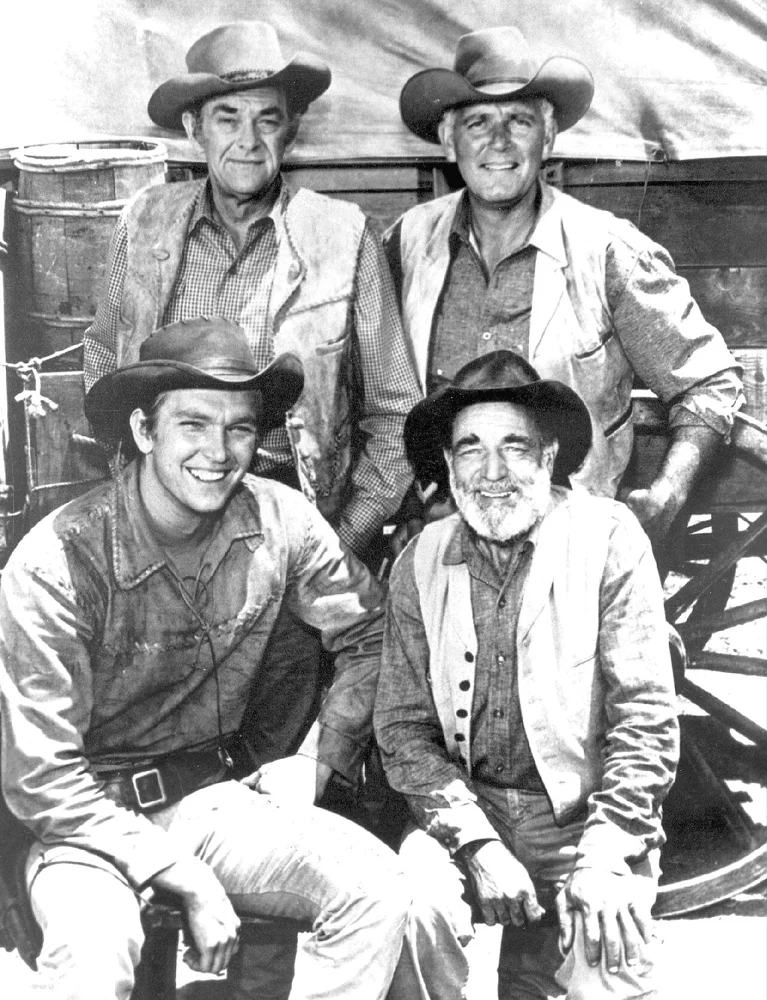
Bill Hawks
Wilson stands at right beside John McIntire; Scott Miller and Frank McGrath are seated.
INSP: The Terry Wilson Story
https://www.insp.com/stories/the-terry-wilson-story/
Museum of Broadcast Communications: Wagon Train
https://www.museum.tv/tv-encyclopedia-18/wagon-train
Terry Wilson: actor career and credits
https://en.wikipedia.org/wiki/Terry_Wilson_(actor)
Commons: portrait provenance and license
https://commons.wikimedia.org/wiki/File:Terry%20Wilson%20Wagon%20Train%201962.JPG
Corrections: hello@dailytimecapsule.com
Work: Terry Wilson Wagon Train 1962.JPG
Creator: ABC Television
Date: 1962-08-16
Original source: https://commons.wikimedia.org/wiki/File:Terry%20Wilson%20Wagon%20Train%201962.JPG
Primary archive: https://commons.wikimedia.org/wiki/File:Terry%20Wilson%20Wagon%20Train%201962.JPG
License: Public domain
License URI: https://commons.wikimedia.org/wiki/File:Terry_Wilson_Wagon_Train_1962.JPG
Changes: Resized and converted to WebP; portrait also placed in a titled share image. No endorsement implied.
Rights scope: No endorsement implied. See the stated license and modification notice.
Work: Wagon Train cast 1962.jpg
Creator: ABC Television
Date: 1962 (source metadata contains an apparent century typo)
Original source: https://commons.wikimedia.org/wiki/File:Wagon%20Train%20cast%201962.jpg
Primary archive: https://commons.wikimedia.org/wiki/File:Wagon%20Train%20cast%201962.jpg
License: Public domain
License URI: https://commons.wikimedia.org/wiki/File:Wagon_Train_cast_1962.jpg
Changes: Resized and converted to WebP; portrait also placed in a titled share image. No endorsement implied.
Rights scope: No endorsement implied. See the stated license and modification notice.