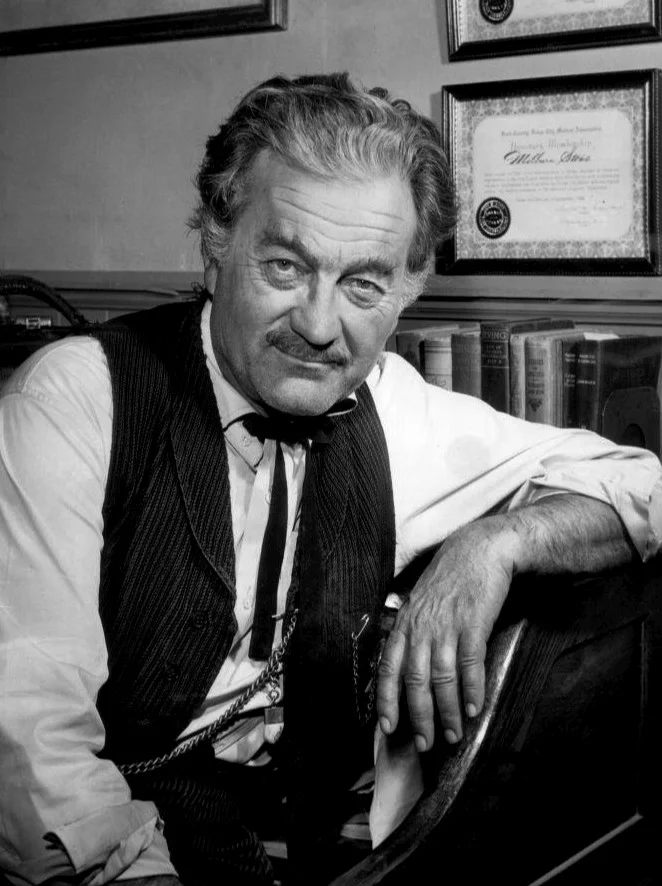
Doc Adams portrait (1959)
Dr. Galen Adams
CBS publicity photograph dated April 10, 1959.
Entry point: Gunsmoke (1955).
Explore the career in pictures
Updated
Milburn Stone was an American actor best known as Dr. Galen Adams, usually called Doc, on the television Western Gunsmoke. The role joined him to one of American television's most durable ensembles and brought him a supporting-actor Emmy in 1968. Yet Doc followed a substantial screen career rather than beginning it. Stone had worked in features and serials before the television series arrived in 1955, and those earlier credits provide a useful counterpoint to the character with whom he became so strongly identified.
Stone was born in Burrton, Kansas, in 1904. He was a nephew of the stage comedian Fred Stone and pursued theatrical work before establishing himself in films. The Los Angeles Times remembrance describes his decision to join a touring company rather than accept an appointment to the Naval Academy. His screen work began in the 1930s. By the time Gunsmoke cast him, he was already an experienced character player, familiar with the demands of making a supporting role clear within a tightly structured story.
The television Gunsmoke began in 1955 after the property had succeeded on radio. The screen version used a different cast, with Stone taking the medical role previously voiced by Howard McNear. James Arness played Marshal Matt Dillon and Amanda Blake played Kitty. Doc's profession gave him a place in stories about injury, danger and the consequences of violence, while his relationships with the regular characters supplied quieter scenes. His importance to the series lies partly in that combination: the doctor belongs to the community even when he is not at the center of an episode's conflict.
Before Doc, Stone appeared in Monogram's Tailspin Tommy adventures and in Chasing Trouble. His association with Universal began in 1943, and the studio used him in both features and serials. The musical I'll Remember April included him as a radio columnist, while The Master Key gave him a leading serial assignment in 1945. These are different kinds of work from a long-running television role. A serial moves through chapter endings and renewed peril; a weekly ensemble allows familiar relationships to accumulate over years.
Stone's exchanges with Dennis Weaver's Chester and later Ken Curtis's Festus became an important part of Gunsmoke's character texture. The friendly friction could provide humor without removing the sense that these people relied on one another. For a rewatch, compare a medical crisis with a conversation between Doc and Festus. One foregrounds professional responsibility, the other the rhythm of a long acquaintance. The 1974 publicity photograph in the gallery pairs Stone with Curtis, while the 1959 portrait presents Doc alone, documenting two periods of the same sustained performance.
The Television Academy records Stone's 1968 win for supporting performance in a drama for Gunsmoke. That official entry confirms the individual award rather than simply the series' reputation. The program remained on television through 1975, and Stone's identification with Doc continued beyond its original run through repeats and public memory. The Los Angeles Times also recalled his appearances on the rodeo and state-fair circuit. Such appearances show how a television character could acquire a public life outside the weekly broadcast without making the actor and the fictional person literally the same.
Stone died on June 12, 1980. An introduction to his work can begin with an early Gunsmoke episode, move to a later story featuring Festus and then turn back to a pre-television film or serial. That route makes both continuity and change visible. The gallery preserves two distinct CBS publicity images and their separate dates. They illustrate the actor's best-known role without implying that his earlier film career consisted only of Western doctors. The selected credits and source records below offer starting points for a broader exploration of his work.
A 1959 portrait and a distinct 1974 ensemble photograph show two periods of Stone's Gunsmoke work.
Dr. Galen Adams
CBS publicity photograph dated April 10, 1959.
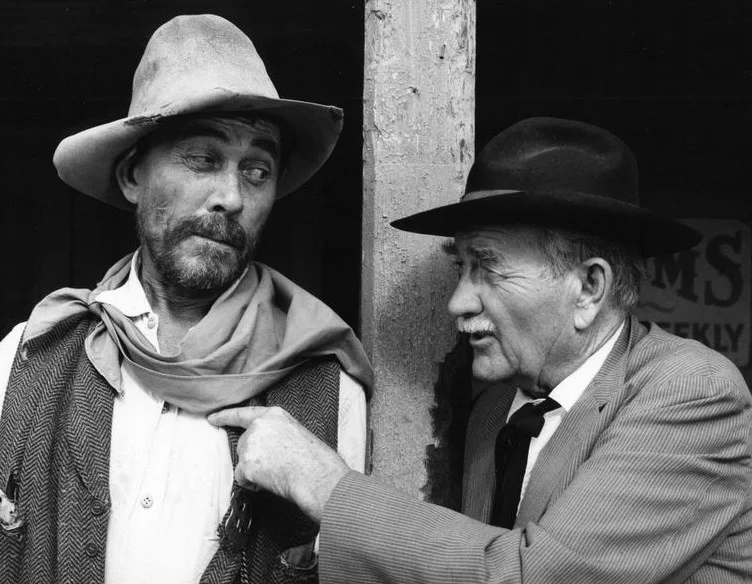
Ken Curtis and Milburn Stone
Curtis as Festus and Stone as Doc Adams in a 1974 CBS publicity photograph.
Television Academy awards record
https://www.televisionacademy.com/bios/milburn-stone
Hollywood Walk of Fame career biography
https://walkoffame.com/milburn-stone/
Los Angeles Times career remembrance
https://projects.latimes.com/hollywood/star-walk/milburn-stone/
Career overview
https://en.wikipedia.org/wiki/Milburn_Stone
Commons: portrait provenance and license
https://commons.wikimedia.org/wiki/File:Milburn%20Stone%20Doc%20Adams%20Gunsmoke%201959.JPG
Corrections: hello@dailytimecapsule.com
Work: Milburn Stone Doc Adams Gunsmoke 1959.JPG
Creator: CBS Television
Date: 1959-04-10
Original source: https://commons.wikimedia.org/wiki/File:Milburn%20Stone%20Doc%20Adams%20Gunsmoke%201959.JPG
Primary archive: https://commons.wikimedia.org/wiki/File:Milburn%20Stone%20Doc%20Adams%20Gunsmoke%201959.JPG
License: Public domain
License URI: https://commons.wikimedia.org/wiki/File:Milburn_Stone_Doc_Adams_Gunsmoke_1959.JPG
Changes: Resized and converted to WebP; portrait also placed in a titled share image. No endorsement implied.
Rights scope: No endorsement implied. See the stated license and modification notice.
Work: Ken Curtis Milburn Stone Gunsmoke 1974.JPG
Creator: CBS Television
Date: Press release is dated 19 July 1974
Original source: https://commons.wikimedia.org/wiki/File:Ken%20Curtis%20Milburn%20Stone%20Gunsmoke%201974.JPG
Primary archive: https://commons.wikimedia.org/wiki/File:Ken%20Curtis%20Milburn%20Stone%20Gunsmoke%201974.JPG
License: Public domain
License URI: https://commons.wikimedia.org/wiki/File:Ken_Curtis_Milburn_Stone_Gunsmoke_1974.JPG
Changes: Resized and converted to WebP; portrait also placed in a titled share image. No endorsement implied.
Rights scope: No endorsement implied. See the stated license and modification notice.